
Your locomotive stalls halfway around the loop, jerks, then dies on the same curve every single time. Most people grab a bottle of isopropyl and a chunk of rough sandpaper, scrub the rails hard, and feel good about it — until the engine stalls again a week later, worse than before. That sandpaper is the culprit: it scratches microscopic grooves into the rail head, and those grooves grab dirt like a magnet.
Here’s the thing about learning how to clean a model train track: the goal isn’t to scrub harder, it’s to lift grime off without scarring the metal. Rails carry the electrical current that runs your trains, so anything that dulls or gouges the surface breaks that connection. Do it gently and correctly, and your engines will glide around the layout the way they did the day you laid the first section of track.
What You’ll Need
- Isopropyl alcohol (90% or higher works best)
- A track cleaning eraser block (the rubbery kind sold for model railroads)
- Several soft, lint-free cloths (old cotton T-shirt material is perfect)
- Cotton swabs for switches and tight corners
- A small stiff-bristle brush (a clean toothbrush does the job)
- A track cleaning car (optional, but great for large layouts)
- Electrical contact cleaner (for stubborn spots and switch points)
- A soft pencil eraser (white, not the pink abrasive kind)
- Rubber gloves
- Good lighting or a small flashlight
One tip from years of doing detail work: keep your cleaning cloths in a sealed bag away from your workbench. Dust and sawdust from scenery projects settle on everything, and a gritty cloth undoes the whole job. A clean rag is half the battle.
Inspect The Rails Before You Touch Them
Before any cleaning, run your finger lightly along a section of rail and look at the tip. If it comes away black, that’s oxidation mixed with dirt and carbon from your engine’s wheels. Now shine a light across the rail head at a low angle. You’ll spot dull, hazy patches where the shine used to be — those are the spots stalling your trains.

Note where the buildup is worst. On most layouts, it’s the curves and the sections closest to where you power the track. Curves get more wheel drag, so grime packs in tighter there.
Loosen Grime With A Track Eraser Block
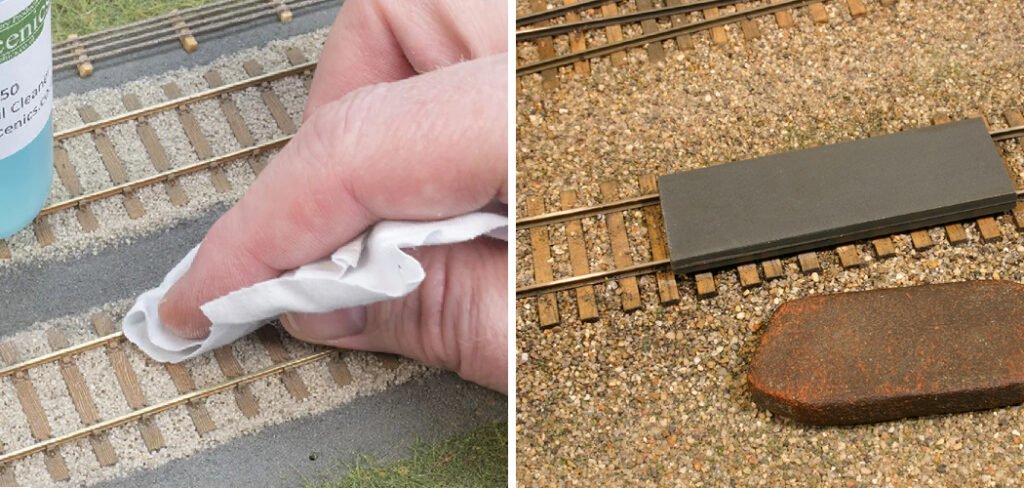
Take your track cleaning eraser and rub it firmly along the top of the rails, following the direction of the track, not across it. Work in short, even strokes over a foot or two at a time.
You’ll see the block pick up a gray-black smear almost immediately — that’s the oxidation lifting off. Keep going until the rail head shows a clean, even shine. Don’t dig in hard; let the rubber grit do the work. Brush the crumbs off with your stiff brush as you go, because those little rubber shavings love to hide in the ties.
For nickel silver rail, this alone handles most of the job. If you’ve got older brass or steel track, you’ll need a bit more elbow grease, since those metals oxidize faster and darker.
Wipe The Rails With Isopropyl Alcohol
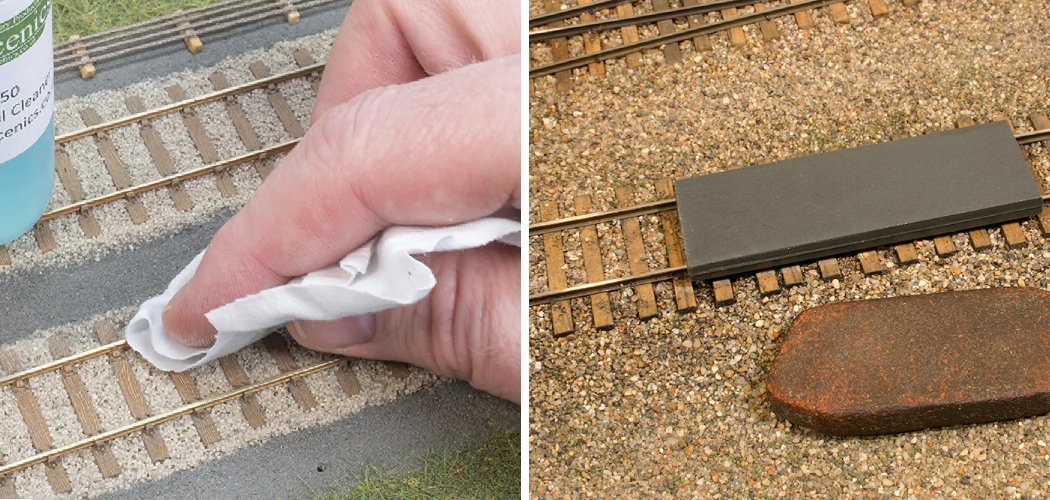
Fold a lint-free cloth into a firm pad and dampen it — not soak it — with isopropyl alcohol. Press it onto the rail head and drag it along the length of the track in one direction.
Watch the cloth turn gray. Refold to a fresh section every couple of feet so you’re always wiping with clean fabric, otherwise you just smear the dirt back down. Run the cloth over both rails and let the alcohol flash off; it evaporates fast and leaves no film, which is exactly why it beats water-based cleaners here.
Clean The Switches And Frogs
Switches (the moving track sections that route trains) are where most stalling starts. The point rails and the frog — that V-shaped crossing piece — collect grime in spots your cloth can’t reach.

Dip a cotton swab in alcohol and work it into the gap where the point rail meets the stock rail. Move the switch by hand as you clean so you catch both positions. For carbon buildup that won’t budge, a swab dipped in electrical contact cleaner cuts through it. Clients who ran big layouts always asked me why their trains derailed at the same switch — nine times out of ten, gunk under the point rail was holding it a hair open.
Clean The Wheels While You’re At It
Dirty track dirties wheels, and dirty wheels re-dirty your freshly cleaned track within a lap or two. Skip this and you’ll be cleaning again by the weekend.
Flip each engine and car over. Hold a swab dampened with alcohol against the wheel tread and roll the wheel across it. On powered engines, you can put a strip of alcohol-dampened paper towel across the rails, set the wheels on it, and apply low power so the driven wheels spin against the towel and scrub themselves clean.
Do A Final Dry Pass
Run a clean, dry cloth along the whole loop one last time to catch any leftover residue or lint. Then set an engine on the track and take it for a slow test lap.
It should run smooth and quiet, with no stalling on the old trouble spots. If one section still hesitates, go back with a swab — you missed a bit of grime there.
What To Use vs. What To Avoid
| Task | Use This | Avoid This |
| Lifting oxidation | Track eraser block | Sandpaper, steel wool, metal files |
| Wiping the rails | 90%+ isopropyl alcohol | Water, household glass cleaner |
| Cleaning switch points | Cotton swabs, contact cleaner | Screwdrivers, sharp metal picks |
| Rail metal (long term) | Nickel silver | Bare steel (rusts fast) |
| Cloth material | Lint-free cotton | Paper towels that shed lint |
| Stubborn carbon | Electrical contact cleaner | Acetone, nail polish remover |
| Polishing shine | Dry soft cloth | Metal polish or wax |
| Reaching corners | Soft toothbrush | Wire brush |
Common Mistakes To Avoid
- Using abrasives like sandpaper or steel wool. They scratch the rail head, and those tiny grooves trap dirt faster than a smooth surface ever would. You’ll be cleaning twice as often.
- Grabbing household glass cleaner. Many contain ammonia, which corrodes brass and leaves a residue that attracts more grime. Plain isopropyl alcohol is the safer, cleaner choice.
- Soaking the track. Dripping alcohol or water down into the ties can seep into cork roadbed and loosen your track glue. A damp cloth is all you need.
- Ignoring the wheels. Clean track plus dirty wheels equals dirty track again in minutes. Always do both in the same session.
- Skipping the switches. People clean the straightaways and forget the moving parts, then wonder why derailments continue at the same spot.
- Applying metal polish. It leaves a waxy film that insulates the rail and blocks electrical contact — the opposite of what you want.
Safety And Warnings
Isopropyl alcohol and contact cleaners are the two products here that need real care, so don’t wing it.
- Ventilate the room. Isopropyl alcohol and electrical contact cleaner both give off fumes. Open a window or run a fan, especially on a big layout where you’ll be working for a while.
- Keep it away from open flame. Alcohol is flammable. No candles, no soldering irons running nearby, no smoking while you work.
- Never mix cleaning products. Don’t combine alcohol with ammonia-based cleaners or bleach. Mixing chemicals can create harmful fumes, and neither belongs on your track anyway. Alcohol alone does the job.
- Read the contact cleaner label. Some formulas are safe on plastic, others aren’t. A cleaner that melts your plastic ties or switch housings will ruin the section. Test a hidden spot first if you’re unsure.
- Wear gloves. Repeated alcohol contact dries and cracks your skin. Thin rubber gloves solve it.
- Unplug the power pack before cleaning switches or wheels by hand so you don’t get a jolt or short something out.
How To Keep Your Model Train Track Clean Longer
Regular light upkeep beats a heavy scrub every time. Here’s the routine that keeps grime from ever building up.
- Run your trains often. Engines that sit idle let oxidation form on the rails. A weekly lap or two keeps the metal bright through simple wheel contact.
- Add a track cleaning car to your consist. Pulling one behind an engine during normal running wipes the rails a little every session, so you rarely need a full teardown.
- Wipe the rails monthly. A quick pass with an alcohol-dampened cloth once a month stops light haze from turning into stalling grime.
- Control the room’s humidity. Damp basements speed up oxidation, especially on brass and steel. A small dehumidifier in summer makes a real difference — I’ve seen the same layout run clean for months in a dry room and gum up in weeks in a humid one.
- Cover the layout when it’s not in use. A simple cloth sheet keeps household dust and sawdust off the rails.
- Clean wheels every few sessions. Dirty wheels are the number one re-contaminator, so stay ahead of them.
- Switch to nickel silver track if you’re rebuilding. It oxidizes far slower than brass or steel and holds a clean electrical surface much longer.
Frequently Asked Questions
How often should you clean model train track?
For a layout you run weekly, a quick rail wipe once a month usually keeps things smooth. If your trains start stalling or hesitating before then, clean sooner. Layouts in dusty or humid rooms need attention more often than ones in a clean, dry space.
Can you use vinegar to clean model train track?
You can use a little diluted vinegar to cut heavy oxidation on brass rail, but rinse and dry it thoroughly afterward — leftover acid keeps corroding the metal. Honestly, isopropyl alcohol and a track eraser do the job with far less risk, so vinegar is a last resort, not a first choice.
Why does my model train keep stalling on clean track?
If the rails look clean but the train still stalls, check the wheels and the switches first. Grimy wheels break contact even on spotless track, and gunk hiding under switch points is a classic culprit. Loose rail joiners can also interrupt power, so wiggle the track to check for gaps.
Is isopropyl alcohol safe for model train track?
Yes, and it’s the go-to for most hobbyists. Use 90% or higher so it evaporates fast and leaves no residue. It’s safe on nickel silver and brass rails and won’t harm most plastic ties, though you should keep it off painted scenery.
What is the best way to clean brass model train track?
Start with a track eraser block to lift the heavy oxidation, then wipe with isopropyl alcohol. Brass tarnishes faster than nickel silver, so you’ll clean it more often. If you’re building a new layout and want less maintenance, nickel silver rail is worth the upgrade.
Should you clean model train wheels too?
Absolutely. Dirty wheels smear grime right back onto rails you just cleaned, so cleaning one without the other is half a job. Roll each wheel across an alcohol-dampened swab, and for powered engines, spin the driven wheels against an alcohol-soaked paper towel.
Final Word
Ditch the sandpaper, reach for an eraser block and a little isopropyl, and always clean the wheels in the same session. Keep a track cleaning car running and wipe the rails once a month, and you’ll spend far more time watching your trains run than fixing why they won’t.
